UK perspective — Lynne Drummond
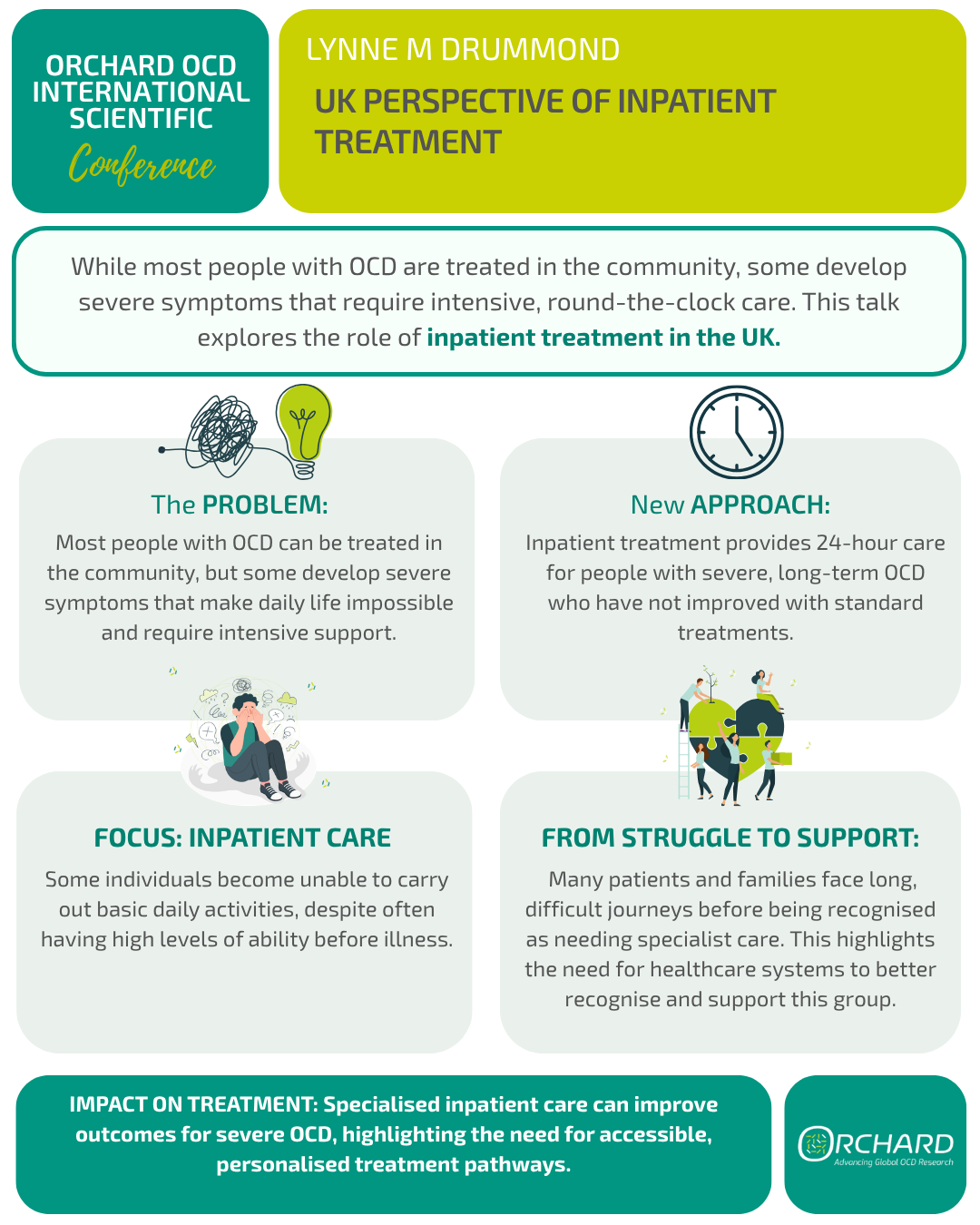
The vast majority of people who develop OCD can be treated in the community. However, those with the most severe symptoms may require 24-hour care to be able to safely manage them. Examples include people who are incontinent due to OCD fears or slowness, those who are unable to get out of bed or whose symptoms render them immobile for many continuous hours as well as those whose symptoms render them incapable of completing even the basic tasks of daily living. This disability is despite the fact that many are highly intelligent individuals who have often demonstrated previous success in life.
In this talk I will briefly discuss the history of developing the UK National Inpatient Service for those with profound, chronic, refractory OCD and the difficulties in convincing authorities of the importance of such a facility. Describing the demographics and individual characteristics of this group and demonstrating the often prolonged and arduous journeys they and their relatives have had to undergo in order to be recognised as needing this specialised help. I will also discuss some of the ways of helping these people and demonstrate that a truly personalised package of care is needed for success. Finally, I will present data on the outcome following inpatient treatment as well as looking towards the future and what we may need in terms of future management and treatment in the UK.
Indian perspective — Janardhan Reddy
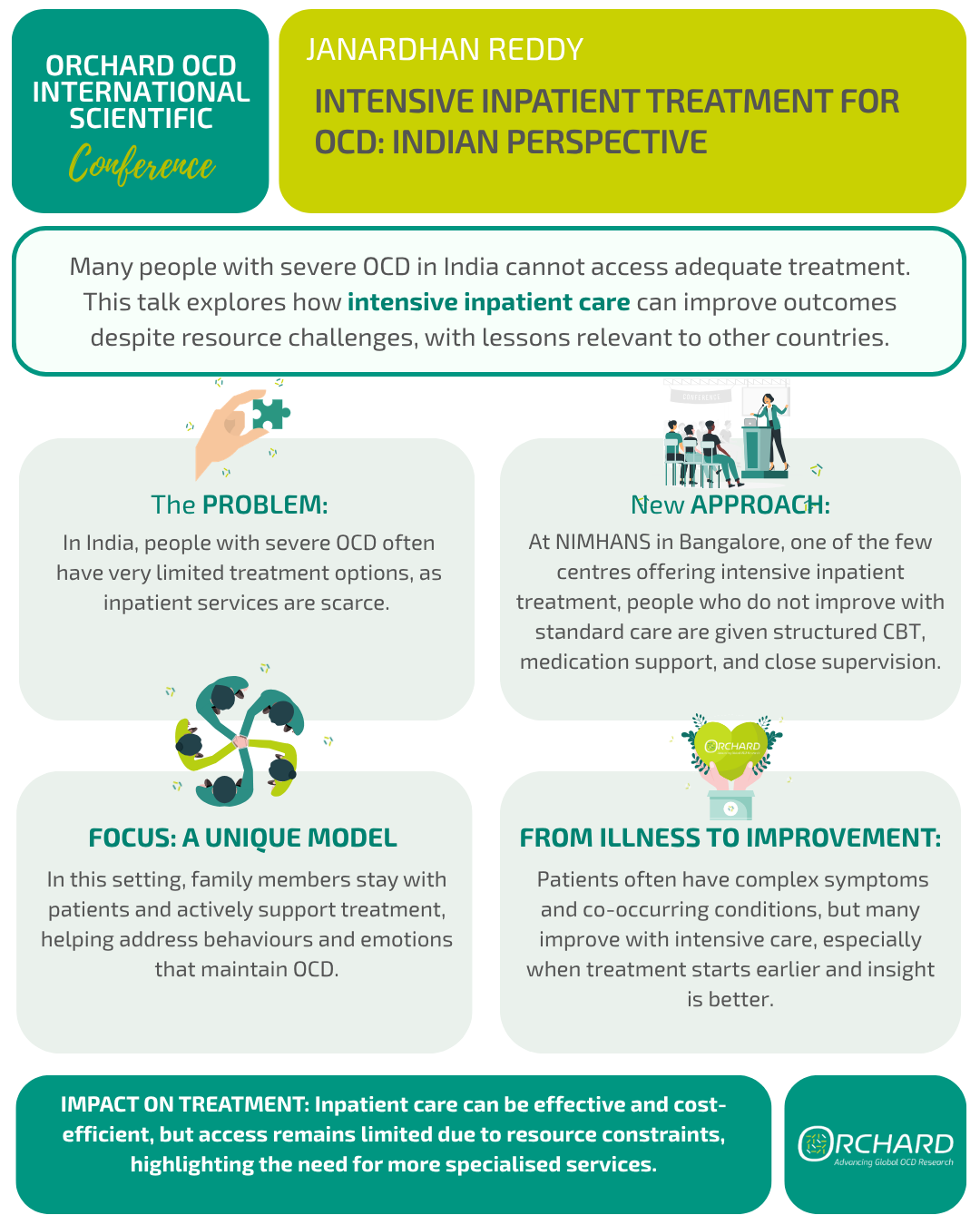
In India, most people with OCD are treated as outpatients, usually with medication such as SSRIs, while only a small proportion have access to cognitive behavioural therapy (CBT).
At the National Institute of Mental Health and Neurosciences (NIMHANS) in Bangalore, the specialist OCD Clinic has provided inpatient care for more than 30 years. In recent years, the number of admissions has grown to more than 100 patients per year, many of whom receive intensive inpatient CBT alongside carefully optimised medication treatment. At the national level, although some academic centres offer inpatient care for those with severe OCD, inpatient services for OCD are mostly non-existent. At NIMHANS, we usually admit only those resistant to multiple pharmacological trials, which constitute the majority, or those with failed outpatient CBT or those who have such a severe OCD that outpatient CBT is not feasible. What is common to all these people is very severe illness, and varying degrees of treatment resistance.
Our inpatient programme differs from many other centres in that close family members stay with the patient throughout the entire period of inpatient care, which lasts on average around six weeks. During this time, the clinical team works closely with families to address family accommodation and emotional responses, and family members are often actively involved in exposure and response prevention exercises. Most of our inpatient population also experience additional mental health conditions alongside OCD, including mood and anxiety disorders, personality disorders, and, more rarely, psychosis.
I will present data from more than 420 inpatients with OCD treated between 2012 and 2017. Around 70% showed improvement by the time of discharge, and approximately 50% maintained these improvements over a two-year follow-up period, although the attrition rate during follow-up was high. Those with shorter duration of illness, better insight and absence of contamination fears fared better. In our inpatient program, these days, we also offer neuromodulation (such as deep transcranial magnetic stimulation) to some of the individuals in addition to CBT. At any point of time, about 20 people with OCD are admitted with us. Because of the increasing demand for inpatient care, the hospital has approved a special OCD ward with 20 rooms (facility built, soon to become operational).
Based on our experience over 3 decades, we strongly recommend intensive inpatient/residential treatment for treatment-resistant patients who do not improve with outpatient care. The Clinical Practice Guidelines (CPG) for OCD developed by the Indian Psychiatry Society (IPS), of which we are the primary authors recommend inpatient treatment for severely ill, treatment-resistant people with OCD.
There are several challenges that are particularly relevant in the Indian context, including a severe shortage of trained therapists and limited availability of inpatient facilities. Another important issue relates to socioeconomic inequalities. Many people with OCD — especially those with contamination fears and prominent compulsions — are reluctant to stay in shared inpatient facilities with common bathrooms, and instead prefer private accommodation. However, private rooms come at an additional cost that many patients cannot afford.
Despite these limitations, I believe our inpatient programme remains highly cost-effective compared with similar facilities elsewhere in the world.